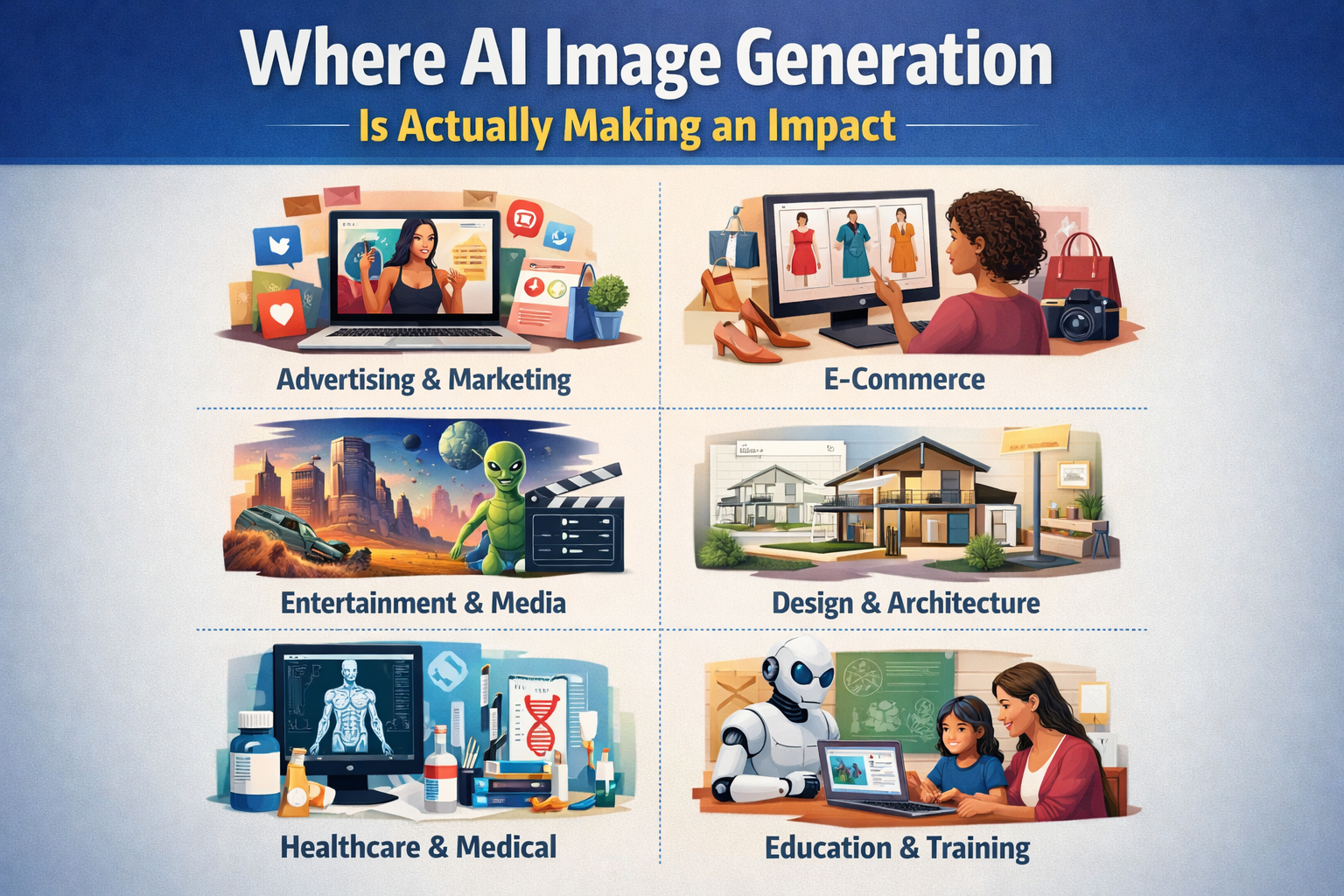
The headlines about AI art tend to focus on the spectacle: a generated image winning an art competition, celebrities pushing back on unauthorized likenesses, copyright lawsuits working through courts.
But beyond the noise, AI image generation is quietly changing how work happens in a lot of industries. Not always dramatically—often just faster iteration, cheaper prototyping, smaller teams doing more.
Here's where it's actually being used, not just hyped.
Game Development
This is one of the clearest use cases. Game studios use AI image generation for:
- Concept art: What does this character look like? Generate 20 variations in an afternoon instead of commissioning 20 sketches.
- Texture generation: Need 15 variations of "weathered stone wall"? AI handles the grunt work.
- Storyboarding: Rough out cinematic sequences before committing to full animation.
- Procedural assets: Background characters, environmental elements, variations on props.
Indie developers especially benefit. A solo creator can now produce visual assets that would have required a small art team a few years ago. The quality bar isn't "replace professional concept artists"—it's "enable people who couldn't afford concept artists to still make something compelling."
Marketing and Advertising
Brands need a lot of images. Social media posts, banner ads, email headers, product mockups. Most of these don't need original photography—they need visuals that are on-brand and appropriate.
AI generation handles the volume work. A marketing team can spin up 50 variations of an ad concept, test them, learn what works, then iterate—all before spending budget on a photo shoot.
The trade-off: AI-generated imagery can feel generic or derivative. The best results come from marketers who understand that AI is a starting point, not a finish line. Generated images often need human refinement, curation, or combination with other assets.
Film and Television
Hollywood's relationship with AI is complicated—writers and actors have legitimate concerns about being replaced. But in production design and pre-visualization, AI is already embedded:
- Pitch decks: Show investors and producers what a film will look like before filming starts.
- Pre-visualization: Rough versions of shots, sequences, and scenes that guide later production.
- Set design concepts: Generate options for environments before building them.
- Storyboard alternatives: Quick iterations on visual narrative.
The key word here is pre. AI handles exploration and visualization. Production still needs human craftspeople to make the actual thing.
Architecture and Interior Design
Architects have always used visualization tools—hand-drawn renderings, then CAD, then 3D modeling. AI is another iteration:
- Rapid concept development for client presentations
- Exploring material and color combinations
- Generating interior furnishing options
- Creating mood boards and atmosphere studies
The advantage is speed. An architect can show a client five distinct aesthetic directions in a single meeting, then refine the chosen one.
The limitation: AI-generated architectural images don't account for structural reality. They're visualizations, not construction documents. They show what something could look like, not how to build it.
Fashion and Apparel Design
This is interesting because fashion has always been visual-first. AI image generation serves a specific niche:
- Pattern and print design
- Color palette exploration
- Seasonal collection mood boards
- Virtual sample generation before physical production
The sustainability angle: generating virtual samples reduces waste from physical prototypes that get discarded. A designer can iterate digitally before committing to fabric.
Publishing and Editorial
Book covers, interior illustrations, article headers. Publishing has always relied on visual assets, and small publishers often have tiny budgets for them.
AI generation doesn't match a professional illustrator's unique voice and craft. But it does make it possible to produce competent visuals on tight budgets—or to quickly generate options before commissioning final art from humans.
Education and Reference Materials
Textbooks, online courses, and educational platforms need a lot of images. Most of them are functional, not artistic: diagrams, examples, illustrations of concepts.
AI handles the functional stuff well. Explaining plate tectonics? Generate a cross-section diagram. Teaching about Renaissance art? Generate images that mimic styles for comparison.
The value is scale: educational content creators can produce more visual learning materials faster, potentially improving comprehension outcomes.
Scientific Visualization
Scientists often need to communicate visually but lack design skills. AI image generation bridges that gap:
- Conceptual illustrations for papers and presentations
- Visualizations of processes that are difficult to photograph
- Educational materials for public communication of science
The caveat: scientific visualization requires accuracy. AI-generated images are interpretations, not evidence. They work for concepts and explanations, not for documenting actual observations.
Small Business and Personal Use
This is the least discussed but perhaps most widespread use case. Small business owners who need:
- A logo or brand imagery
- Social media content
- Product mockups for online stores
- Presentations and marketing materials
Many of these people would never have hired a designer. AI generation isn't replacing professionals—it's enabling creation that wouldn't have happened at all.
The Pattern
In almost every case, AI image generation is doing one of three things:
- Accelerating iteration — more concepts, more variations, faster exploration
- Reducing barriers — enabling creation by people who couldn't afford professional services
- Handling volume — producing the 90% of visual assets that need to be competent, not exceptional
It's not replacing human creativity. It's changing where humans focus their creative energy—less on routine generation, more on direction and curation.
The industries that adapt well are the ones that treat AI as a creative partner, not a replacement. The tool can generate. The human still decides what's worth making.