Here's something most people don't think about when they generate an AI image: that creation required computing power. Significant computing power. Running a modern image generation model isn't something you do on a laptop—it takes serious GPU muscle.
And that creates a problem.
The Centralization Problem
When OpenAI releases DALL-E, they control who uses it, how they use it, and what they pay. When Stability AI runs Stable Diffusion on their servers, they're the gatekeepers. The compute, the models, the access—all concentrated in the hands of a few companies.
This isn't necessarily malicious. Running AI at scale is expensive. Training a model like Stable Diffusion XL costs hundreds of thousands of dollars in compute. Operating the servers to handle millions of image generations daily? More millions in infrastructure.
But concentration of power has consequences:
- Pricing power. When there's no competition, subscription prices climb.
- Access control. Companies can restrict who uses their tools and for what purposes.
- Transparency gaps. Users have no insight into how models are being updated or modified.
- Censorship pressure. A single provider can be pressured to restrict or remove capabilities.
The question becomes: can we build AI tools that serve the public interest without requiring a billion-dollar company to run them?
A Different Model: Distributed Computing
What if, instead of one massive datacenter running everything, we had thousands of smaller contributors each providing a slice of compute?
It's not a new idea. SETI@home did it for decades with radio telescope data. Folding@home simulates protein folding for disease research. The concept: idle compute power exists everywhere. Gaming PCs sit dormant while their owners sleep. Render farms cycle between projects. Home servers run at a fraction of capacity.
What if that idle compute could power AI art?
The Artfelt Approach
This is the model we've been building at Artfelt. Instead of centralizing all image generation on our own servers, we're developing a distributed network where:
Contributors provide compute. Anyone with a capable GPU can run an Artfelt node, processing image generation jobs for the community.
Users get access. When you generate an image on Artfelt, it might run on a GPU in a datacenter, or it might run on someone's gaming PC across the world.
The network coordinates. Jobs are routed to available nodes, load is balanced automatically, and the whole system scales with demand.
It's not that different from how BitTorrent works—distributed resources, coordinated through software, serving a community need.
Why This Matters
Lowering Barriers to Entry
New AI art platforms typically face a chicken-and-egg problem: you need users to justify the expensive infrastructure, but you need infrastructure to attract users. Distributed computing changes the equation. The compute capacity grows organically with demand.
Environmental Efficiency
Building a new AI datacenter has a significant carbon footprint. Manufacturing servers, cooling systems, construction. By contrast, utilizing existing idle hardware is remarkably efficient—those GPUs already exist, already have power supplies and cooling, and are already connected to the internet.
We're not saying distributed computing has no environmental impact (the compute still runs, power still flows). But compared to building fresh infrastructure for every AI service? It's a meaningful improvement.
Resilience and Independence
A distributed network has no single point of failure. No one server outage takes down the entire service. No one corporate decision cuts off access. The community that uses the tool also sustains it.
Transparent, Open Development
When the community provides the compute, the community has a voice. Open models mean anyone can inspect, modify, and improve the software. Security researchers can audit for bugs. Artists can request features. The development isn't happening behind closed doors.
The Vision
We're not there yet—not fully. Building distributed AI infrastructure at scale is genuinely hard. But we're committed to the direction.
Because the alternative—AI concentrated in fewer and fewer hands, controlled by a handful of companies, accessible only to those who can pay—doesn't feel like the future we want.
AI art should be abundant, affordable, and accessible. Not because it's a loss leader for a tech giant, but because it's powered by people who believe that creative tools should belong to everyone.
If you have a GPU and want to be part of building this future, we'd love to have you. And if you just want to make art, that's perfectly fine too—the network exists to serve you.
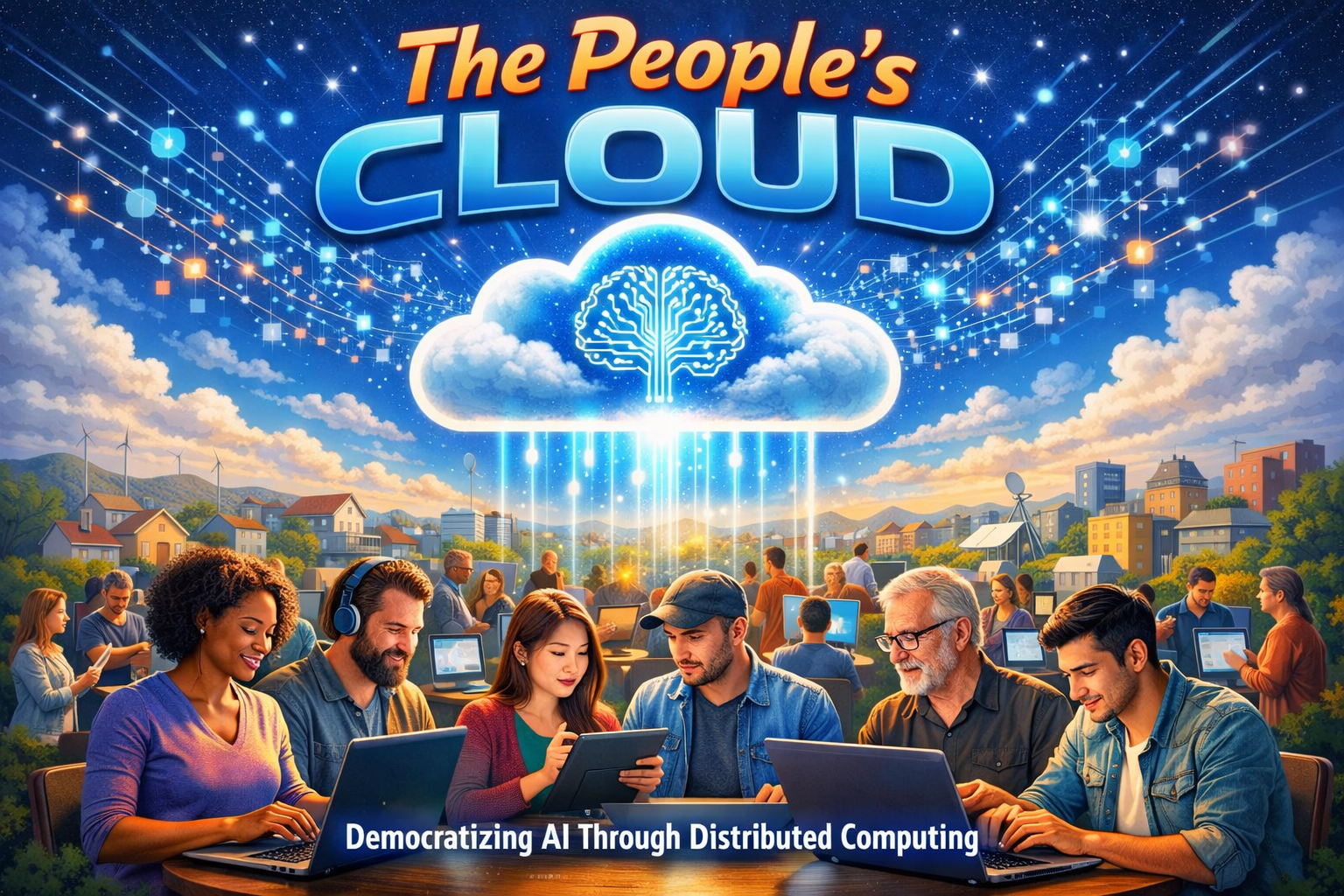
The People's Cloud
Every time someone adds a compute node to the network, the infrastructure gets a little more distributed. A little more resilient. A little more democratic. A little less dependent on any single company or investor.
One GPU at a time, we're building the people's cloud. And it's going to be beautiful.