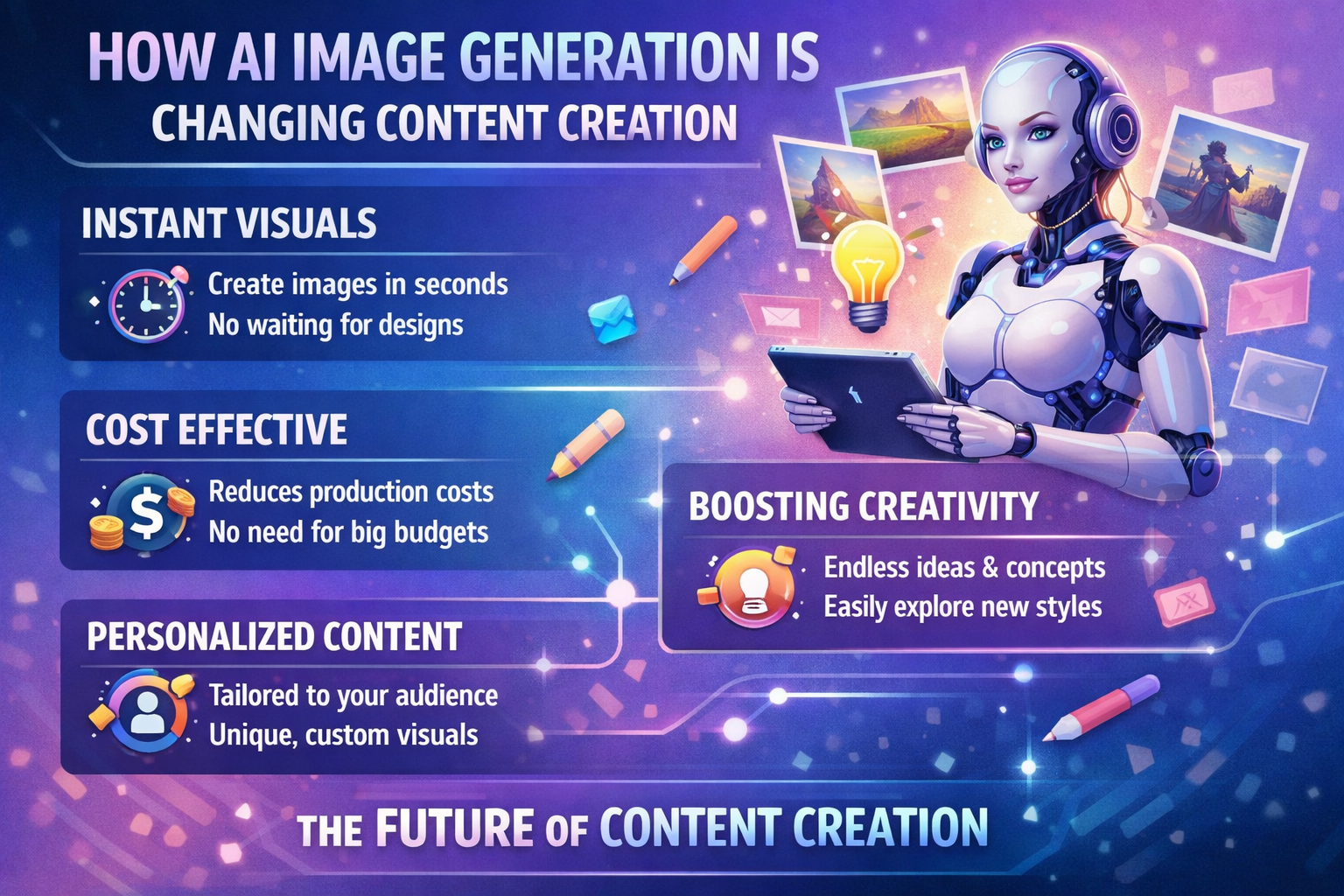
Content needs visuals. Blog posts need headers. Social media needs posts. Presentations need slides. Newsletters need something besides walls of text.
For a long time, getting good visuals meant one of three things: hire someone (expensive), buy stock photos (expensive and generic), or make it yourself (time-consuming and often amateurish).
AI image generation didn't eliminate these options. It added a fourth: generate it in minutes, for free or close to free, at quality that ranges from "good enough" to "genuinely striking."
Here's how that's changing the actual work of content creation.
The Speed Shift
A newsletter author used to spend hours finding the right stock image—or skip visuals entirely. Now they can generate a custom image that matches the tone of their piece in the time it takes to write a paragraph.
A product team used to wait weeks for concept art from designers. Now they can rough out a dozen directions in an afternoon and narrow down before bringing in humans for refinement.
The change isn't just speed; it's iteration. When generating an image takes 30 seconds instead of 3 hours, you try more things. You explore directions you'd have skipped. You discover happy accidents.
The Democratization Question
"Democratizing design" is an overused phrase, but something real is happening here.
People who couldn't afford visual content can now produce it. Small businesses, independent creators, educators, community organizations—lots of people operating with limited resources now have access to visual creation tools.
The result isn't always professional-grade. But "professional-grade" isn't always the requirement. A local nonprofit's Facebook post doesn't need agency-quality graphics. It needs something that communicates clearly and doesn't look broken.
AI generation makes "good enough" accessible. That's not nothing.
Personalization at Scale
One of the more interesting applications: generating variations.
Instead of one image for a marketing campaign, a brand can generate 20 variations—different styles, different compositions, different demographics represented—and test which performs best. Or personalize automatically: different images for different audience segments, generated programmatically.
This would have been prohibitively expensive with traditional design. AI makes it possible to test and iterate at a scale that wasn't practical before.
The Creative Block Solution
Every content creator knows the feeling: you know what you want to say, but you can't visualize it. Or you're not even sure what you want to say visually, and that's blocking everything.
AI generation breaks that block. Type a rough idea, get an image. It might not be the final image—but it's a starting point. Something to react to. A direction to pursue or reject.
Sometimes the image that comes out isn't usable, but it sparks a better idea. The AI becomes a collaborative partner that doesn't judge your half-formed thoughts.
What About Quality?
Here's the honest truth: AI-generated content is not automatically good.
The tools are accessible, but using them well is still a skill. Prompt engineering matters. Curation matters. Knowing when an AI image works and when it obviously doesn't.
The best content creators using AI tools are the ones who:
- Generate more than they need and select the best
- Combine AI elements with other assets
- Know when AI isn't the right tool
- Edit and refine rather than using raw outputs
- Understand their audience and what resonates
The tool changes the creation process. It doesn't eliminate the need for judgment.
The Stock Industry Response
Stock photo agencies are in an interesting position. Their business model—selling licenses for generic images—directly competes with AI generation that can produce custom visuals for free.
Some are integrating AI into their offerings. Some are suing AI companies for training on their images without permission. Some are pivoting to premium, exclusive, and rights-managed content that AI can't easily replicate.
For content creators, the calculation is simple: if you need a photo of "diverse team in office with laptop," you can license it from a stock site for $10-30, or generate something similar for free. The stock image might be more polished. The generated image might be more specific to your needs. Both options now exist.
The Frictionless Creation Model
At Artfelt, we built around a specific principle: the less friction between idea and image, the more ideas get visualized.
No account required to start. Type, generate, see if it works. If it doesn't, try again. If it does, save it.
The old model—sign up, choose a plan, purchase credits, generate within limits—assumes commitment before exploration. We think the relationship should work the other way: explore first, commit if it's valuable.
This matters for content creators. When the barrier to trying something is near zero, you try more things. Some of them work.
What Changes, What Doesn't
AI image generation changes:
- The speed of visual iteration
- The cost of producing multiple variations
- The accessibility of custom imagery
- The threshold for "worth visualizing"
It doesn't change:
- The need for creative direction
- The value of professional design for high-stakes projects
- The importance of matching visuals to audience and context
- The requirement that content actually be good
The tool is powerful. The judgment about when and how to use it—that's still human.